Digital credentials
Digital credentials let you securely share information about yourself online or in person. Your credentials are stored in a digital wallet on your device, and you control what information you share.
What are digital credentials
You can use digital credentials to share verified information about yourself. Examples include:
- personal details — such as your name, date of birth, qualifications or address
- organisational information, such as a business’ verified bank account number or IRD number
- information about people you’re authorised to act on behalf of, such as a child or a company.
Digital credentials make it quicker and easier to access services. They reduce the need for face-to-face interactions and physical documents, while giving you more control over the information you share.
Many countries, including Australia, are using digital credentials as a safer, more efficient and private way to share details.
Using digital credentials is optional. You can continue using physical documents if you prefer.
Benefits of digital credentials
- Better privacy — share only the information needed, reducing the amount of personal information organisations collect and store. For example, you can prove you’re over 18 without sharing your full date of birth.
- No tracking — your use of digital credentials is private and there is no central record of where or when you use them.
- Secure by design — digital credentials are stored in a digital wallet on your mobile phone. They’re protected by encryption and your device’s security features, so no one else can access them.
- Control over what’s shared — you choose what information to share and can see exactly what’s being requested. Your information is verified digitally, with no need to hand over your device.
- Available offline — you can use digital credentials in person without an internet connection.
Are digital credentials the same as RealMe?
No — RealMe helps you prove who you are online, while digital credentials let you share verified information about yourself (such as your age or qualifications), both online and in person.
How digital credentials work
1. Your identity is checked
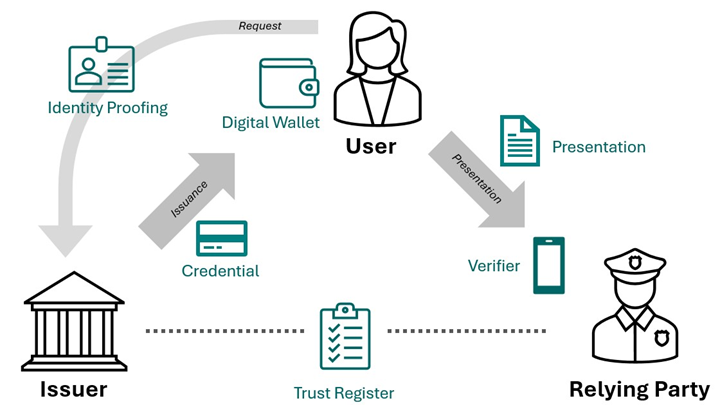
To start, you request a digital credential from the trusted organisation who issues it (the ‘issuer’). The organisation then confirms your identity to help ensure the credential belongs to the correct person (‘identity proofing’).
2. A trusted organisation issues the credential
Once your identity has been verified, the organisation issues you a digital credential.
Organisations that issue digital credentials can choose to become accredited under the Digital Identity Services Trust Framework. This shows they meet recognised standards for privacy, security and information management.
Read more about how digital credentials are regulated
3. You store the credential in a digital wallet
The credential is stored securely in a digital wallet on your device. It’s linked to you using a biometric, such as your fingerprint or Face ID (facial recognition), so only you can use it.
You can use the Govt.nz app’s digital wallet to store accredited credentials. In the future, you may also be able to store credentials in other digital wallets.
4. You choose what information to share
When you need to prove something about yourself, you can share your digital credential with an organisation, either in-person or online (‘presentation’).
You use your fingerprint or Face ID to access and share it. This confirms that the credential belongs to you.
5. The organisation verifies your credential
The organisation receiving your credential (‘relying party’) verifies that it’s genuine and was issued by a trusted source. This can be done in person or online using the NZ Verify app or other verification tools. The ‘Trust Register’ helps organisations check that the service is accredited.
How digital credentials are regulated
In New Zealand, rules for accredited digital credentials are set by the Digital Identity Services Trust Framework Act .
Digital credentials accredited under the Trust Framework have shown that their services meet robust privacy and security requirements.
The Trust Framework Authority regulates accredited providers. It:
- makes sure providers continue to meet accreditation requirements
- responds to complaints
- investigates when rules are not followed
- helps ensure New Zealand’s digital identity system operates as intended.
About the Trust Framework Authority — Public Service Commission | Te Kawa Mataaho
Using digital credentials
The Govt.nz app is the first place digital credentials will be available. More ways to access and use digital credentials will become available over time.
Visit the Govt.nz app support page to see:
- how to use digital credentials in the app
- what credentials are available in the app
- frequently asked questions about digital credentials.